
Italian ruscus is an evergreen perennial shrub throughout all of its life. The shoots are covered with a dark green bark.
Longitudinal pronounced grooves can be observed on the shoots. The leaves are ovate, they are quite dense.
Flower buds are formed from the leaves, they rise on small peduncles. Flowering occurs in April and May. The flowers are small purple or white in corollas.
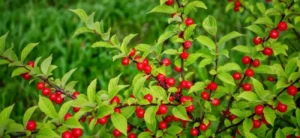
Italian ruscus is a dioecious indoor culture, therefore it can only reproduce by cross-pollination. When pollinated, a huge number of small beautiful, bright red berries will appear on the bushes.
But ripe fruits are considered only as an ornament, as they are poisonous and inedible.
Today, there are many different species of butchers.
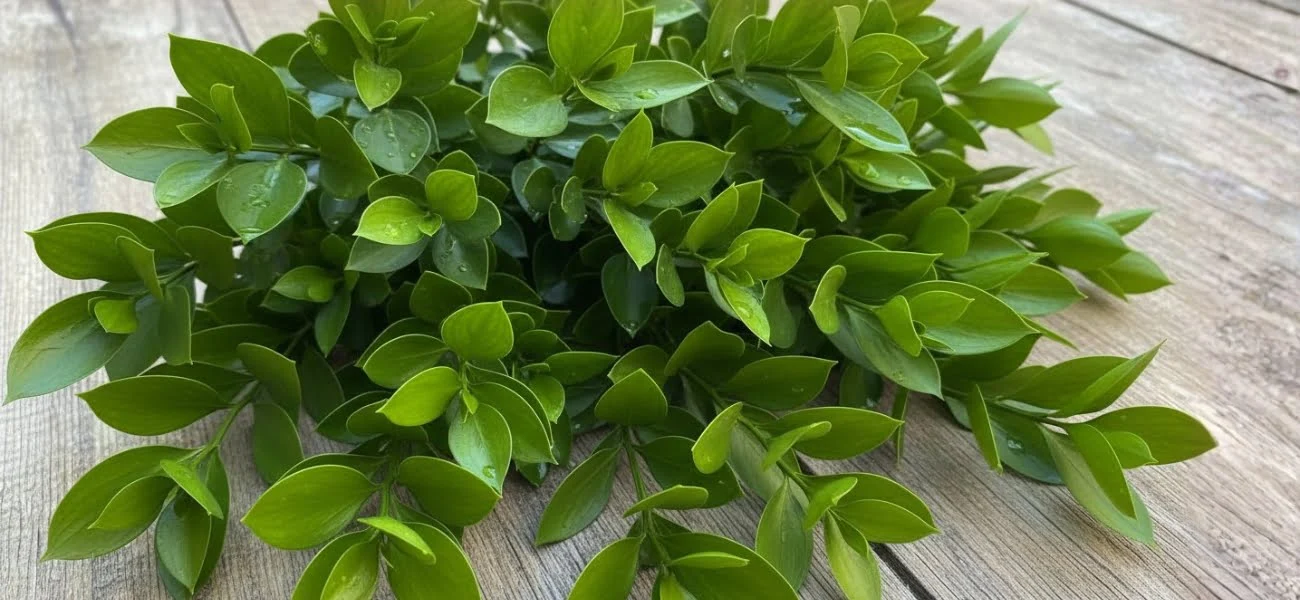
Italian Ruscus Greenery
Pontic (prickly, italian ruscus aculeatus).The branches on it are even, slightly deviated. The height of this italian ruscus does not exceed 100 centimeters. The leaves of the plant are long and narrow, their shape is subdual. On the leaf blades, lateral and median veins are visible, the length of which does not exceed 3 cm. The flowers are small, purple-green. They are located at the bottom of the ruscus. The fruits are small berries of dark red color. This flowering period remains from September to January. The Pontic butcher can bloom only in the tenth year of life.
Italian Ruscus Plant
Ground tongue:
The hyoid butcher is a perennial herbaceous plant, the height of which is 30-40 centimeters. Its leaves are dark green, slightly pointed. The flowers are green. The fruits are red. The plant blooms from the month April to May in each year.
Colchis:
This italian ruscus looks like a sprawling bush, consisting of numerous flexible shoots, the length of which does not exceed 50-55 cm. The leathery leaves are dark green in color. During the flowering period, the plant is completely covered with small buds with lanceolate bracts. The Colchis variety blooms from October to January.
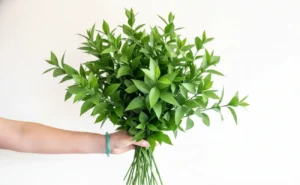
Italian Ruscus (underleaf, hypophyllum):
This species has straight, long shoots. The foliage of the plant is a beautiful emerald shade, the shape of the leaf plates is oblong. Adult height bush reaches to 45-50 cm. Small flowers open on the plant only at the end of the winter season. They are white or light blue. This plant looks very decorative.
Hyrcanian, This perennial butcher reaches a height of 25-40 cm. It has a ribbed stem. The leaves are rich green in color, they can be ovate, oblong or ordinary lanceolate.
We will analyze how to properly plant indoor ruscus.
Almost any soil is suitable for butcher’s broom. But it is important that it is breathable and permeable to water. You should not use too oily and dense soils. A drainage layer must be laid at the bottom of each pot, this will prevent the appearance of stagnant water after watering.
Conditions
Butcher’s broom always grew indoors at room temperature. But in summer, experts recommend taking it with a pot outside of the house. It is important to maintain optimal air humidity, although Italian ruscus can adapt to room humidity. In this case, regular spraying will be useful.
In hot weather, the plant should also be periodically washed under a warm shower. In this case, the container is closed with a bag.
Watering
It should be watered sparingly. The soil dries out 3-4 centimeters among treatments. After the fruit set, gradually reduce flowering watering to prepare the vegetation for a dormant period.
Pruning
Pruning of plants is carried out only as needed
All cuts should be immediately treated with wood ash.
Transfer
If necessary, the bush can be transplanted in the spring. When transplanting into a larger pot, side shoots will begin to appear on the plants, while the bush will become as lush as possible. A deep capacity is not needed, since the root system grows only in width.
The bush plant is carefully removed from the old pot. The ground is cleaned from it, dried roots are immediately removed. At the same time, a soil mixture is prepared, mixing leaf and sod soil for this purpose.
Good drainage is made at the bottom of each new pot, and then a soil mixture is made. The bushes are installed evenly in a vertical position in prepared containers. On the sides, they are gradually covered with earth.
Remember that the root neck can only be slightly deepened by 1-2 cm. After the procedure, the vegetation is watered. At the same time, water stagnation should not be allowed. The liquid from the pallets must be drained. The butcher’s broom tolerates transplantation relatively easily, so soon after the procedure, active growth of the plant is already observed.
Reproduction Of Italian Ruscus Greenery
Firstly, cuttings are cut, their maximum length should be between 10-13 centimeters. Moreover, the lower cut should be oblique, and the upper – even.
Then the cut branches are placed in Kornevin’s solution for several hours.
After some time, the branches are planted in a pot filled with soil with nutritious fertilizer. Then the pots with branches are placed on pallets. The cuttings are also covered with glass jars.
When new shoots appear at the base of the cuttings, the glass jars are removed.
And the plant is also propagated by seeds. It was described above.
Italian ruscus can also be propagated by division. After that, it is cut into several parts with a garden knife.
In this form, everything remains for 5-6 days. Immediately before use, the finished tincture is diluted with water in a 1: 1 ratio.
Thrips can also settle on such a plant. When they appear on the russula, light dots and spots of various sizes appear. To destroy thrips, insecticide treatment should be carried out.
Mealybugs can also attack vegetation. The parasite quickly sucks out all the juices from the butcher, as a result of which the growth and development of Italian ruscus is significantly slowed down. In addition, a black bloom will begin to form on the surface of the bushes, and a specific sugary discharge may appear.
To get rid of the mealybug, all damaged parts are first removed, then treatment with preparations is carried out (“Actellik”, “Inta-Vir”, “Tsvetofos”). Then pour a little crushed soap there. The finished composition is mixed well. Treatment with such a solution is carried out 3-4 times.
Sometimes scale insects also appear on Ruskus. In this case, a sticky liquid forms on the leaves, spots of red, yellow and brown color. Chemical insecticides (“Fufanon”, “Arrivo”, “Fitoverm”) are most often used to combat pests.
Sometimes a simple toothbrush is taken. With its help, all parasites are carefully removed from the plant. After that, it is thoroughly wiped with a sponge, and then sprayed with a simple soap solution.
Ruskus has bactericidal properties, therefore it is very resistant to diseases, and is able to independently cope with various infections, including fungal infections. For the prevention of diseases, the root system is cut off during transplantation, as well as soil disinfection.