
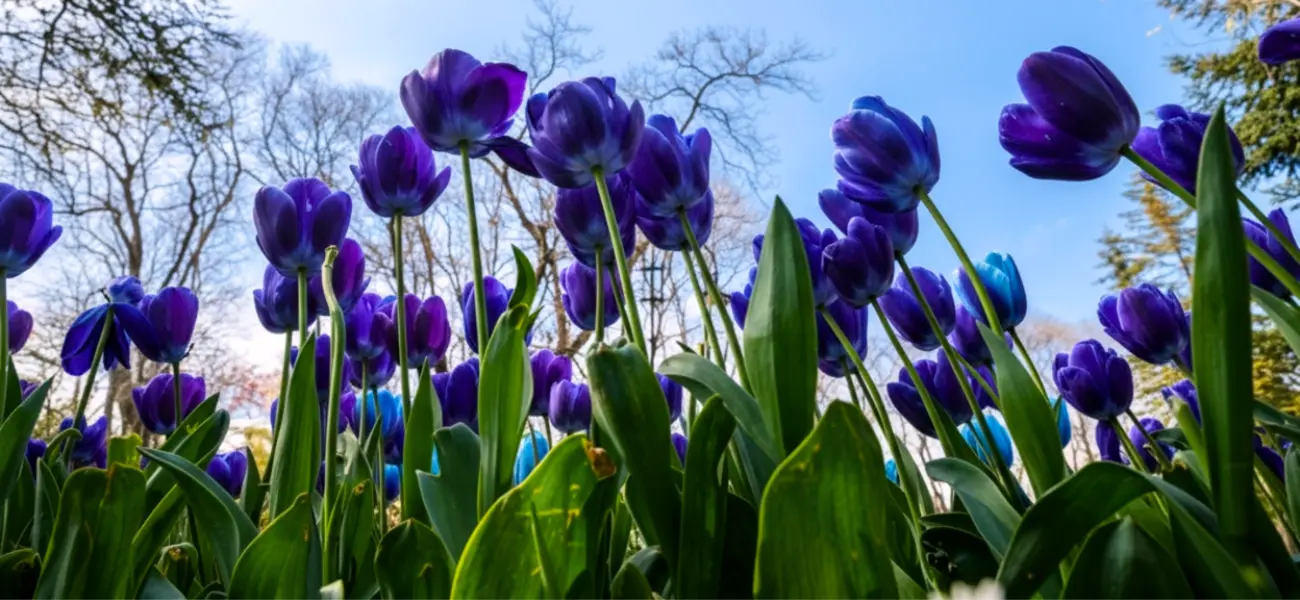
If you have a big love for flowers, then you ever wondered about the blue Tulips. It is that kind of flower which gives fairytale vibes. A mystery of little bit and little of romance. This flower used to be associated with love for someone and the spring season.
What exactly are Tulips?
Before we get to the “blue” part, a quick background. Tulips are known as one of the most famous and popular flowers in the world. They have a simple shape, a small cup like a long stem standing on it. You can often see tulips in:
Red (most classic)
Yellow (happy and cheerful)
Pink (sweet and romantic)
White (clean and elegant)
Purple (Royal appearance)
These flowers you can mostly see in cold climates, most probably in Europe. Honestly, It looks simple, because tulips have their own unique charm.
Why Are There No Naturally Blue Tulips?
This is the most important part. In fact, there are no naturally blue tulips in the world. This is not because they have not been discovered yet—but because of science itself. Flowers color comes from pigments, and it is meant to be truly blue, because it needs a specific pigment which tulips are unable to reproduce naturally.
Every flower has “ingredients” for color
Tulips, lack the “ingredient” for true blue
So no matter what you do, if we are just talking about natural growth, they will not really be blue.
But Why Do We See “Blue Tulips” Online?
That’s it. This is what can be confusing sometimes. If you search online, you will definitely see pictures of Blue Tulips. Even more beautiful—like an edited painting. So what’s going on?
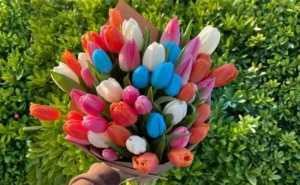
Here’s the truth:
1. Dyed Tulips
- This is the most common.
- They take white tulips
- They water them with blue dye (color)
- The petals gradually turn blue
It seems like magic, but technically… they are not natural.
2. Edited Photos
- Yes, sometimes the explanation is simple—Photoshop.
- Adjusting the color
- Making the blue more vibrant
- Sometimes it’s too perfect
- So if it’s too beautiful and seems unreal, it’s probably edited.
3. Hybrid Experiments
- Many scientists in the world are searching for new ways to create from scratch.
- The flower’s DNA is being studied
- Trying to introduce the blue pigment
- But until now, there has been no real success available on the market.
Blue Tulips Meaning?
Because it is rare—or technically, unnatural—they have their own symbolism.
And honestly, their meaning is beautiful.
Common Meanings:
- Mystery
- Uniqueness
- Impossible love
- Poetic, right?
Why Do People Love?
Simple: because they don’t exist.
It’s human nature that we are more attracted to rare or unique things.
Some characteristics of it:
- Red tulips → common (even if beautiful)
- Blue tulip → rare (even if unnatural)
That’s why many people are obsessed with the idea of this flower. They seem to symbolize “something different.”
How to Have Blue Tulip (Even If Not Natural)?
If you really want to have it in your home, there is a way.
Option 1: Dyed Tulips
One of the easy ways to do it.
You need:
- White tulips
- Blue food coloring
- Water
- Vase
Steps:
- Fill the vase with water
- Mix the blue food coloring
- Add the white tulips
- Wait a few hours until the color changes
Option 2: Buy Pre-Dyed Tulips (Dummy Tulips)
- Some flower shops (especially online) sell dyed tulips.
- Ready-made
- More consistent color
- Perfect as a gift
What about Tulips as a Gift for someone who you admire:
The answer should be yes always.
They’re perfect if:
- You want to give something different
- The gift has special meaning
- The recipient likes unique things
But be careful if:
- The person is traditional (maybe they prefer red or pink)
- They don’t like artificial colors
Personal Take: Are Blue Tulips Worth It?
If you were to ask me? Yes—but not because they’re “real.”
What I like about the idea behind them.
It’s like a reminder:
- Not everything beautiful is natural
- Not everything impossible is boring
- Some of the fun Facts About Tulips
To help you appreciate them even more:
- Mania” where they are so expensive (like cryptocurrency now)
- Tulips have edible parts (but it is not recommended to eat them casually)
FAQs About Blue Tulips
Are there Blue Tulips?
They do not grow naturally by itself because it’s lacking specific pigment to grow
Are these Blue Tulips being fake?
They are not totally fake—but most are just dyed or edited.
Are dyed tulips safe?
Yes, they are generally safe as decorations. Just don’t eat them.
Can you grow Blue Tulips in the garden?
If you are looking for something natural, no. But you can dye white tulips after you grow them.
What is the closest color to blue tulips?
Purple or violet. This is the closest natural shade.
Final Thoughts
These are one of those things that are better in idea than in reality. And that’s okay. Even though they are not natural, they carry a unique charm—the kind that will make you think, smile, and sometimes even dream. And honestly, in a world full of the usual and predictable, sometimes we also need a little “impossible.”
Even if it’s just the blue color of a tulip
They took the blue pigment gene from another flower (like the iris) and inserted it into tulips. It was a long process—over 20 years of study. And the result? A tulip that was closer to blue than ever before. But this one is not “sky blue”. It is more like a violet which is so close to blue even you could call it blue mistakenly. Then they called it as “Applause” variety
My personal opinion? Their hard work and dedication was admirable. But at thousands of dollars per bulb (yes, it’s true), it’s still not for the masses. It’s only for researchers or lab people that want to do more research. The Symbolism of Blue Tulip: You Don’t Need the Real to Be a Good Symbol.